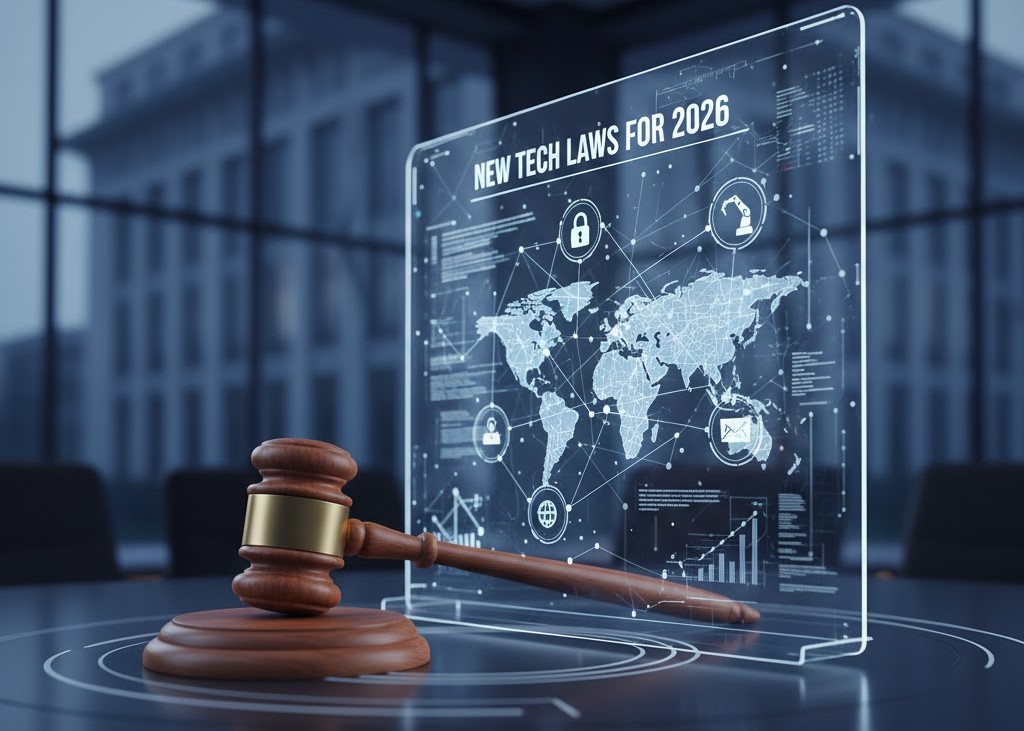
As of early 2026, the global technology landscape is undergoing a massive shift from “voluntary ethics” to hard, enforceable laws. Governments are moving past simple guidelines to establish strict penalties and mandatory audits for AI, data privacy, and digital safety.
Here is a summary of the most significant tech laws taking effect in 2026:
The EU AI Act (Full Implementation)
The world’s first comprehensive AI law reaches its most critical milestones this year.
* August 20, 2026: This is the “General Applicability” date. Almost all provisions of the Act become legally enforceable.
* High-Risk Systems: AI used in critical infrastructure, recruitment, education, and law enforcement must now meet strict “conformity assessment” standards before they can stay on the market.
* Fines: Non-compliance can result in massive penalties—up to €35 million or 7% of global annual turnover, whichever is higher.
US State Privacy “Second Wave”
While a federal privacy law remains in debate, several major state laws and amendments take effect on January 1, 2026:
* New States: Comprehensive privacy laws go live in Indiana, Kentucky, and Rhode Island, giving millions of citizens the right to delete, port, and opt-out of data collection.
* Neural Data Protection: New amendments (notably in California and Connecticut) now classify brain-computer interface (BCI) data as “sensitive,” requiring the same protection as medical records.
* Universal Opt-Out: In several states, businesses are now legally required to recognize “Universal Opt-Out Signals” (like Global Privacy Control) automatically.
Digital Governance & Online Safety
Regulators are tightening rules on how platforms interact with users, especially minors.
* UK Online Safety Act: Full enforcement of the “Safety by Design” requirements is in effect, forcing social media companies to actively prevent the spread of illegal content or face billions in fines.
* Nigeria’s “Digital Nigeria 2026” & Startup Act: A new legal framework for the digital economy focuses on digital signatures, paperless government, and a revised Startup Act to encourage tech investment while protecting consumer rights.
* The “Right to Explanation”: Under updated GDPR and local laws, if an AI denies you a loan or a job, the company is now legally required to provide a clear, human-readable explanation of the automated decision.
Energy & Sustainability Mandates
* Eco-Design for Smartphones: New laws in various regions (led by the EU) now mandate that gadgets sold in 2026 must be designed for repairability, with batteries that are either easily replaceable or significantly more durable.
Tech Laws – Implication For Social Media
Social Media: The “End of Infinite Scrolling”
This 2026, tech laws are not just about general privacy anymore; they are more focused and specific. The social media industry is going through major changes.
Mandatory Age Gating: Social media platforms are now required to check a user’s age. In many places, like Virginia and some areas of the EU, accounts for people under 16 must have a daily time limit of one hour set automatically.
Algorithmic Responsibility: Under the “Safety by Design” rule, platforms can be fined huge amounts of money if their recommendation systems are found to “actively promote” harmful content, like self-harm or extreme dieting.This is even if the platform didn’t host the original content.
The “Triple Shield” Protection: Big platforms now have to give users, especially adults, tools to filter out “legal but harmful” content, such as online abuse or anonymous trolling. This gives users a way to have a “clean feed” option.
Influencer Disclosures: In 2026, new laws closed gaps in “deceptive marketing.”A I-created influencers or “virtual humans” must now have a permanent digital watermark or label that shows they are not real people.